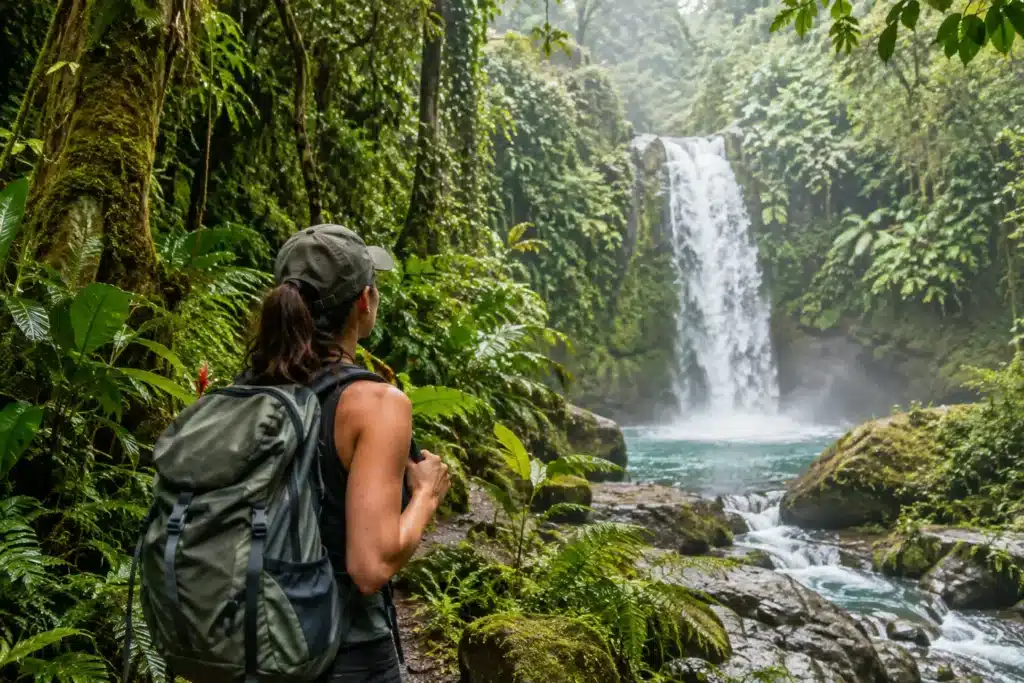
A waterfall trail asks more of your footwear than a stroll through a dry forest. One moment, you may be walking beneath a warm canopy; the next, stepping over roots softened by rain or standing near mist-polished stone. If you are wondering which shoes for waterfall trails will feel secure, graceful, and comfortable in Costa Rica, begin with one priority: choose footwear made to stay stable when the landscape is beautifully wet.
The right pair lets you remain present for the experience itself – the fragrance of damp earth, the sound of rushing water, the cool touch of rainforest air – rather than watching every step with concern. For most guided waterfall walks in Guanacaste, a lightweight, closed-toe hiking shoe or trail runner with dependable grip is the most considered choice.
Which shoes for waterfall trails offer the best balance?
A low-cut hiking shoe is the strongest all-around option for travelers who want protection, traction, and polish without the weight of a traditional boot. Look for a sole with deep, widely spaced lugs that can grip uneven earth, wet leaves, and slick stone. A shoe that feels firm underfoot but flexible through the forefoot will make natural movement easier on trails with roots, gentle inclines, and occasional stream crossings.
Trail-running shoes can also work beautifully, particularly for active travelers who prefer a lighter feel. They tend to drain and dry faster than many hiking shoes, and their flexibility can be welcome in tropical heat. The trade-off is durability and protection: a very minimal trail runner may leave your feet more exposed to sharp rock or a misplaced step.
For a more demanding route, or for guests who know they want extra ankle support, a lightweight hiking boot can be appropriate. Choose one that is already broken in. New boots, however beautiful, can turn a day of rainforest immersion into an afternoon of blisters. A boot should support your ankle without feeling stiff, heavy, or overly warm.
The finest choice is not necessarily the most technical-looking shoe. It is the pair that fits securely, grips confidently, and allows you to move through the rainforest with ease.
Why wet traction matters more than waterproofing
Many travelers instinctively reach for waterproof footwear. In a rainforest setting, waterproofing can be useful during a brief shower or shallow puddle, but it is not the deciding feature. Water eventually finds its way in – whether through the ankle opening, a stream crossing, or sustained rain – and fully waterproof shoes can take longer to dry once soaked.
Prioritize outsole traction first. Rubber compounds designed for wet terrain, with a patterned tread that sheds mud rather than collecting it, offer meaningful confidence around waterfalls. Test the sole with your hand before traveling. If it feels hard and plastic-like, it may not provide the reassuring grip you want on smooth surfaces.
Quick-drying materials are often more practical than heavily insulated waterproof membranes in Guanacaste’s warmth. Mesh panels, synthetic uppers, and drainage-friendly construction can keep a shoe from feeling waterlogged after a humid morning or a splash from the trail. The ideal result is not perfectly dry feet at every moment. It is feet that remain comfortable, stable, and ready for the next part of the journey.
Closed-toe shoes protect the experience
Waterfall trails can include loose gravel, concealed roots, low vegetation, and stones shaped by years of moving water. Closed-toe footwear protects against the small, avoidable discomforts that interrupt an otherwise restorative day: a stubbed toe, a thorn, a scrape against rock, or an unexpected insect encounter.
This is why casual flip-flops are rarely a wise choice beyond a poolside setting. Their smooth soles offer little grip, their straps can shift when footing changes, and they leave the foot exposed. Fashion sandals, even those with a sturdy appearance, often become slippery when wet and do not offer enough stability on uneven ground.
A high-quality sport sandal can be suitable for a very short, well-maintained path or a planned river activity, provided it has an adjustable heel strap and a serious rubber sole. Still, for a full waterfall trail, a closed-toe hiking shoe remains the more comfortable and protective choice for most guests. It also leaves you free to pause at a viewpoint, descend toward a cascade, or follow your guide’s invitation to explore without reconsidering your footing.
Fit is a luxury you can feel all day
Even exceptional traction cannot compensate for an imperfect fit. Your toes should have a little room to move downhill without pressing into the front of the shoe, while your heel should remain comfortably anchored as you walk. Try shoes on with the socks you intend to wear, ideally later in the day when feet are naturally a bit fuller.
Avoid footwear that requires a lengthy break-in period. A short walk around town is not the same as several hours in humid terrain. Wear your chosen pair on neighborhood walks before your trip, including a few stairs or hills if possible. You are looking for a quiet kind of confidence: no rubbing at the heel, no pressure across the toes, no sliding inside the shoe.
Thin, moisture-wicking hiking socks are a thoughtful companion. Cotton socks absorb water and can stay damp against the skin, increasing the chance of friction. Merino-blend or synthetic socks move moisture more effectively and remain comfortable even when the trail is damp. Bring a spare pair in your day bag for the pleasure of changing after the walk, before a thermal soak or a leisurely meal.
Choose footwear for the trail you will actually walk
Not every waterfall encounter requires the same shoe. A groomed path with broad walkways calls for less technical footwear than a natural forest trail with roots, mud, and uneven descents. Weather also changes the equation. A route that feels easy after a dry spell may become more demanding after an afternoon rain.
Ask about the expected terrain rather than relying on photographs alone. Consider the length of the walk, elevation changes, whether there are stream crossings, and whether you will be entering the water. For private, guided rainforest experiences such as those at Sensoria, local guides can offer terrain-specific advice and help guests move at a pace that honors both safety and wonder.
If your itinerary combines hiking with thermal pools, do not expect one pair of shoes to do every job. Wear your hiking shoes for the trail, then pack a simple pair of secure sandals for pool areas and changing spaces. Separating those roles keeps your trail footwear supportive and your relaxation time effortless.
A few details worth packing
Footwear works best as part of a considered trail kit. A small dry bag or reusable waterproof pouch protects a fresh pair of socks and your phone. A lightweight towel can be useful after a stream crossing or waterfall swim. If rain is forecast, keep your shoes somewhere ventilated overnight rather than sealed in a plastic bag.
Before setting out, check your laces and remove any small stones caught in the tread. These modest preparations may seem ordinary, yet they create more room for the extraordinary: a hidden cascade appearing through the trees, the movement of a bird overhead, the hush that follows rain.
Choose shoes that respect the terrain and support your body, then let the rainforest do what it does best. With secure footing beneath you, each wet stone and winding path becomes less of an obstacle and more of an invitation to awaken your senses.